
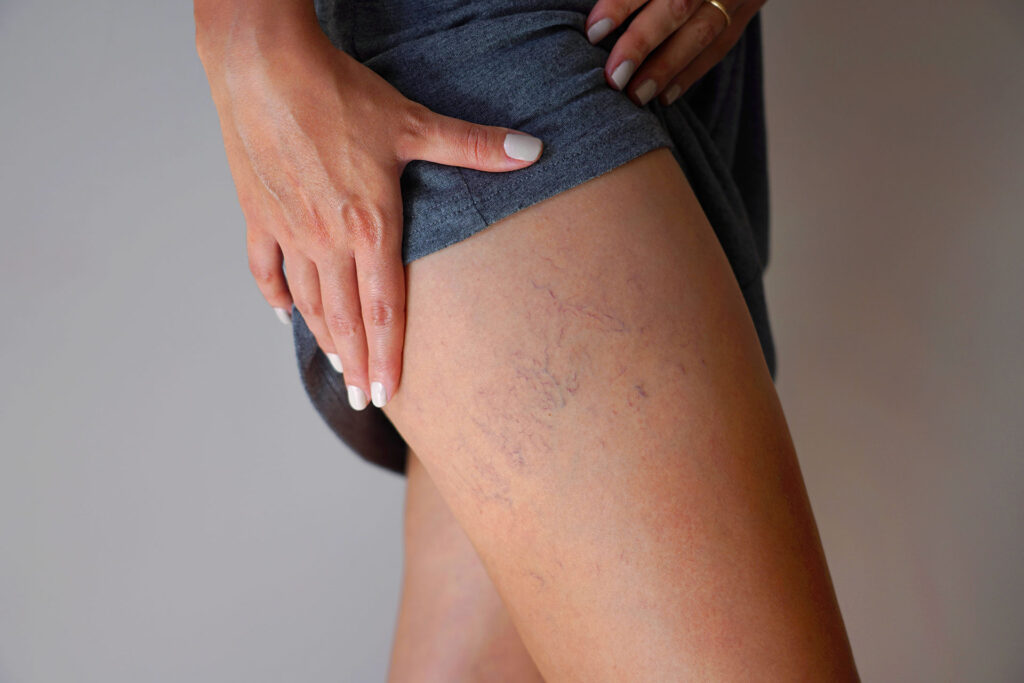
It starts small, a faint smudge near the ankle, a brownish shadow on the skin you barely notice at first. Then time passes. Weeks, months, and gradually your legs begin to feel different, uneven, patchy, darker in places you never expected to change.
Discoloration on the legs is common and often misunderstood. While it may look like a surface-level issue, the underlying cause can run much deeper.
How Discoloration Gets Its Start
Your veins have one main job: carrying blood back to the heart. Inside them are tiny one-way valves that prevent blood from flowing backward. When these valves begin to weaken, blood can pool in the lower legs and pressure gradually builds.
Over time, a few things can happen:
- Small blood vessels may become more fragile and leak
- Iron from red blood cells can seep into surrounding skin tissue
- The skin slowly develops a brown, rusty, or purplish tint
Because of gravity, the lower legs, especially the ankles, are affected most. That’s often where discoloration first becomes visible.

Can You Reverse It When Legs Are Purple?
Sometimes, but not always completely. In many cases, the condition can be improved, and progression can often be slowed or stopped.
When the underlying vein issue is treated, circulation can improve. Blood flows more efficiently, pressure in the veins decreases, and inflammation can reduce over time. As a result, skin changes may gradually soften, and areas of discoloration can lighten in some patients.
However, the outcome depends on timing and severity. Early evaluation and treatment tend to offer better results, while long-standing changes may be more resistant. Even so, addressing the underlying vein problem can help prevent further worsening and support healthier circulation moving forward.
How Vein Specialists Approach It
When veins begin to function poorly, the goal is straightforward: restore healthy blood flow, reduce pressure, and allow the skin to recover. Understanding what causes discoloration in the lower legs is key, so vein treatment an address the underlying issue rather than just the surface changes. Vein specialists use several minimally invasive options to do this.
Sclerotherapy
A solution is injected into the affected vein, causing it to gradually collapse and fade. Over time, circulation improves in nearby healthy veins, and skin tone may slowly become more even as pressure decreases.
Venous Ablation
With Venous Ablation, heat is used inside the vein to close it from within. Blood is naturally redirected to healthier vessels, improving overall circulation. With reduced venous pressure, skin changes may gradually improve over time.
ClariVein®
This technique combines gentle mechanical action with a targeted solution to close the vein efficiently. It is designed to minimize discomfort while addressing the underlying source of reflux.
VenaSeal™
A small amount of medical adhesive is used to seal the vein shut. The treated vein is then gradually absorbed by the body while blood flow shifts to healthier pathways.
Across all approaches, the focus is the same: improve circulation at the source so the skin and surrounding tissues can recover as much as possible over time.
Taking Charge of Skin Discoloration on Legs
Your skin isn’t just a surface, it can reflect what’s happening deeper in the body. If you notice persistent discoloration on the legs, especially patches that linger, darken, or appear alongside swelling or discomfort, it may be worth having it evaluated.
Modern vein treatments can help reduce venous pressure, improve circulation, and support skin recovery, often without the need for major surgery or extended downtime.
Early evaluation can make a difference, helping preserve skin health and prevent further progression.
Frequently Asked Questions
Your skin isn’t just a surface, it can reflect what’s happening deeper in the body. If you notice persistent discoloration on the legs, especially patches that linger, darken, or appear alongside swelling or discomfort, it may be worth having it evaluated.
Modern vein treatments can help reduce venous pressure, improve circulation, and support skin recovery, often without the need for major surgery or extended downtime.
Early evaluation can make a difference, helping preserve skin health and prevent further progression.
Don’t let varicose veins slow you down, contact us today.